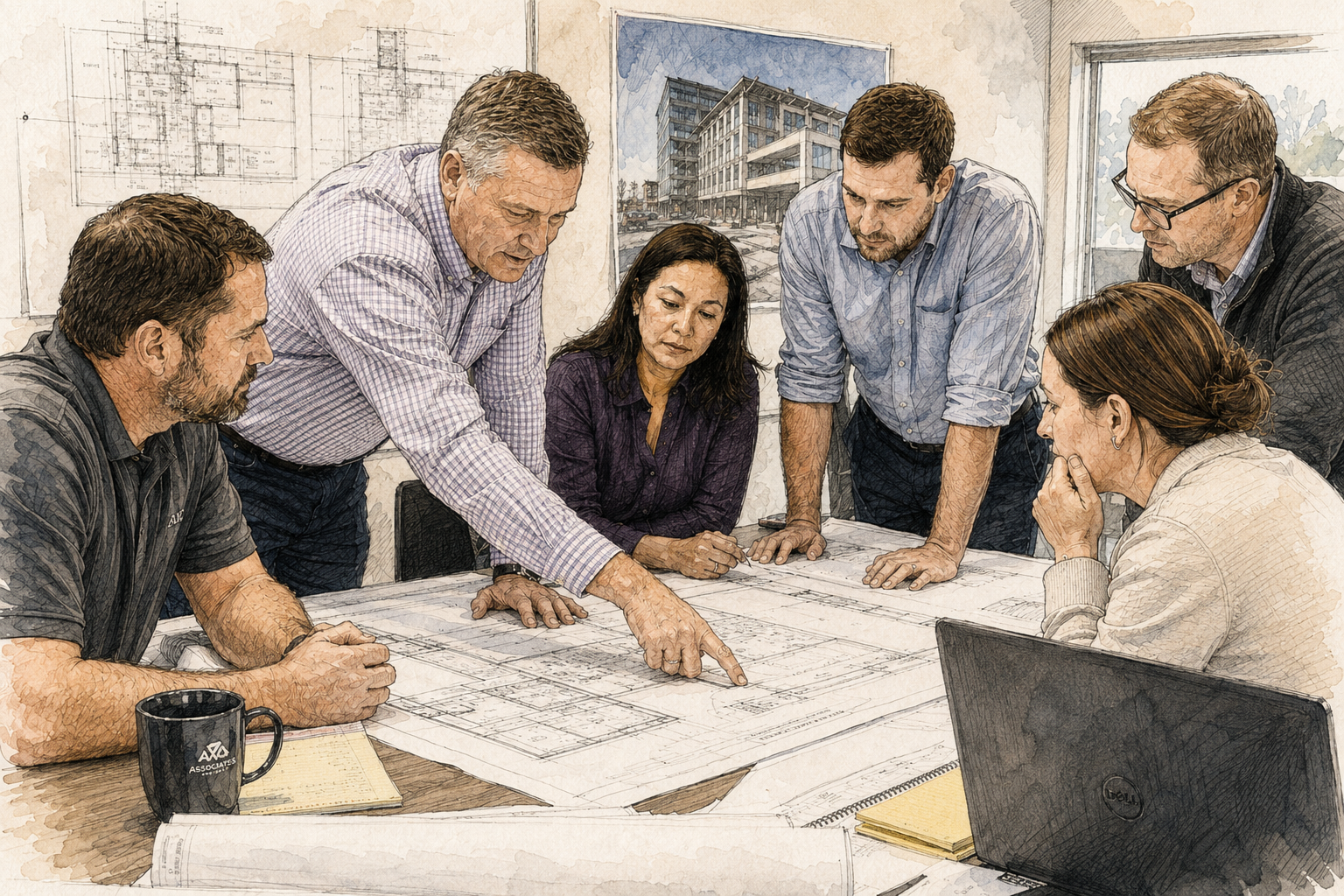
Commercial construction costs are shaped long before crews arrive at the jobsite. Early design decisions affect materials, building systems, labor, procurement, scheduling, and how easily the project can be constructed.
For that reason, waiting until the design is complete to involve a contractor can limit an owner’s options. A decision that looks reasonable on paper may be expensive, difficult to build, or dependent on materials with long lead times.
Early contractor involvement brings construction knowledge into the planning and design process. As a result, owners and designers can review cost, constructability, scheduling, and procurement before major decisions become difficult to change.
This approach does not guarantee a lower final price. However, it can provide better information when the team still has time to respond.
What Is Early Contractor Involvement?
Early contractor involvement means adding a contractor or construction manager to the project team during planning or design rather than waiting until the drawings are complete.
During this stage, the contractor does not simply provide a price. The contractor may review:
- Conceptual budgets and design estimates
- Construction methods and sequencing
- Building systems and material selections
- Site access and existing conditions
- Permit and inspection requirements
- Labor and subcontractor availability
- Long-lead materials and equipment
- Project phasing and scheduling
- Potential scope gaps and project risks
In addition, the contractor can explain how specific design decisions may affect the budget or schedule. The owner and design team can then evaluate those options before construction documents are finalized.
The Federal Highway Administration notes that early contractor involvement gives project teams access to construction knowledge about pricing conditions, labor, materials, equipment availability, constructability, and alternative methods. Its guidance on early contractor involvement also explains how earlier collaboration can support cost and risk management.
How Early Involvement Helps Control Commercial Construction Costs
Early involvement does not reduce costs through one single action. Instead, it improves the quality and timing of the information used to make project decisions.
The following areas often have the greatest effect on cost control.
1. The Budget Develops Alongside the Design
A project budget created from an early concept will change as the design becomes more detailed. The problem occurs when the design develops without regular cost checks.
For example, the design team may add structural features, finish materials, mechanical systems, or specialty equipment without seeing the combined effect on the budget. By the time the contractor prices the completed documents, the project may no longer align with the owner’s available funds.
With early contractor involvement, estimating can occur at key design milestones. Therefore, the team can compare the developing scope with the budget while meaningful options remain available.
During commercial preconstruction planning, Builders United reviews budget development, estimating, constructability, value options, and material procurement with owners and design teams.
2. Constructability Issues Can Be Found Earlier
A design may meet the owner’s goals and still create construction challenges. Limited access, crowded ceiling spaces, conflicting building systems, difficult installation sequences, or incomplete details can lead to added work in the field.
Constructability review examines how the project will actually be built. For example, the contractor may identify:
- Conflicts between structural and mechanical systems
- Materials that are difficult to install in the proposed location
- Insufficient access for equipment or deliveries
- Details that require extensive custom fabrication
- Work that may interfere with occupied areas
- Missing scope between design disciplines
When these issues are found during design, the team can evaluate alternatives in an organized way. By contrast, discovering them during construction may require revised drawings, new pricing, schedule adjustments, or rework.
3. Material Decisions Can Reflect Current Market Conditions
Material selection affects more than appearance. It can influence availability, installation time, labor requirements, maintenance, and replacement costs.
In addition, some specified products may have long manufacturing or delivery periods. Others may require specialty installers who are difficult to secure within the project schedule.
Early contractor involvement allows the team to review availability before the design becomes dependent on a specific product. If needed, the contractor can help compare alternatives based on:
- Initial purchase cost
- Installation requirements
- Expected lead time
- Availability of qualified installers
- Durability and maintenance
- Compatibility with other building systems
- Effect on the construction schedule
As a result, the owner can make a broader cost decision rather than choosing an option based only on its unit price.
4. Long-Lead Procurement Can Begin Earlier
Electrical equipment, mechanical units, elevators, specialty finishes, kitchen equipment, switchgear, and custom products can affect the critical path of a commercial project.
If the team identifies these items late, the project may face an extended schedule or an expensive substitution. However, early procurement planning gives the team time to confirm specifications, release approved packages, or evaluate alternate products.
The Federal Highway Administration also identifies early material purchasing and contractor input as ways collaborative delivery methods can improve schedule confidence and control cost growth. Its project-delivery guidance emphasizes verified pricing, risk coordination, and earlier procurement.
5. The Team Can Plan Around Existing Conditions
Renovations and tenant improvements carry risks that may not be visible in the original drawings. Existing utilities, undocumented changes, hazardous materials, structural limitations, and outdated building systems can affect the scope.
For that reason, the contractor should review the site and available documents before the design is finalized. Depending on the project, the team may also recommend exploratory demolition, scanning, testing, or additional surveys.
These steps do not eliminate every unknown condition. Still, they can reduce the number of assumptions used to develop the budget.
Early Contractor Involvement Is More Than Value Engineering
Early contractor involvement is often associated with value engineering. However, value engineering should not mean removing features simply to reduce the price.
A useful value review considers the function, performance, durability, schedule, and cost of a design decision. In some cases, the best option may cost less. In other cases, spending more on one system may reduce maintenance, shorten installation, or avoid later replacement.
Examples may include:
- Comparing structural or mechanical systems
- Reviewing standard materials against custom products
- Simplifying details that require extensive field labor
- Changing equipment locations to improve installation access
- Evaluating prefabricated components
- Reviewing finish selections against durability requirements
- Adjusting project phasing to reduce operational disruption
The goal is to protect the project’s priorities while making informed decisions about where the budget creates the most value.
How Early Planning Reduces Change-Order Risk
Not every change order is avoidable. Owners may change the scope, existing conditions may differ from available records, and agencies may require revisions during review.
However, some changes result from incomplete coordination, unclear scope, missing details, or decisions that were postponed until construction.
Early involvement can help the team identify questions such as:
- Who is responsible for each part of the scope?
- Are owner-purchased items included in the construction plan?
- Does the building have enough electrical or mechanical capacity?
- Are utility upgrades required?
- Do the drawings reflect actual site conditions?
- Are allowances based on realistic information?
- Does the schedule account for permitting and procurement?
- Are all design disciplines working from the same requirements?
As these questions are resolved, the estimate becomes more specific. The owner can also see which items remain uncertain and determine how much contingency should be carried.
How Collaboration Improves Cost Decisions
Cost control is not solely the contractor’s responsibility. Owners, designers, engineers, contractors, trade partners, and suppliers may all hold information that affects the budget.
For example, the architect understands the design intent. The engineer understands system performance. The contractor understands sequencing and field conditions. Trade partners understand installation requirements and current market availability.
When those perspectives are brought together early, the team can review a decision from several angles. This does not mean every participant will agree immediately. Instead, it creates a process for evaluating the tradeoffs before work begins.
The Design-Build Institute of America describes design-build as a single point of responsibility in which design and construction participants work together throughout the process. Its design-build best practices also stress collaboration, risk management, and clear project execution procedures.
Project Delivery Methods That Support Early Involvement
Early contractor involvement is not limited to one contract type. Several delivery methods can bring construction knowledge into the design process.
Design-Build
Under Design-Build, the owner contracts with one primary entity for both design and construction. Designers and construction professionals work as an integrated team.
This structure can support continuous cost, schedule, procurement, and constructability reviews as the design develops. However, the owner still needs clear goals, performance requirements, decision procedures, and budget expectations.
Learn more about Builders United’s commercial Design-Build services.
Construction Manager at Risk
With Construction Manager at Risk, or CMAR, the owner generally hires the designer and construction manager under separate agreements. The construction manager participates during design and later serves as the general contractor.
This approach can give the owner a direct relationship with the designer while adding construction estimating, scheduling, procurement, and constructability input before construction begins.
Learn more about CMAR project delivery.
Design-Assist
Design-Assist brings contractors, specialty subcontractors, or trade partners into the design process while the owner maintains separate design and construction relationships.
This can be useful for projects with complex systems, specialized materials, detailed coordination, or technical installation requirements.
Learn more about Builders United’s Design-Assist services.
What Happens During Commercial Preconstruction?
The exact process depends on the project, delivery method, and stage of design. However, commercial preconstruction commonly includes several connected activities.
Scope and Goal Review
The team begins by clarifying the owner’s operational needs, quality expectations, schedule, budget, and approval process. Without this direction, the project may be designed around assumptions that do not support the owner’s priorities.
Conceptual Estimating
Early estimates may be based on square footage, comparable projects, assemblies, or preliminary quantities. As the design progresses, those estimates should become more detailed.
Design-to-Budget Reviews
At defined milestones, the team compares the design with the current budget. If a gap develops, the team can identify the cause and evaluate options before moving into the next stage.
Constructability and Coordination
The contractor reviews the drawings for access, sequencing, system conflicts, incomplete details, and conditions that may be difficult or expensive to build.
Schedule Development
The project schedule should include design decisions, agency reviews, procurement, construction activities, owner-furnished equipment, inspections, commissioning, and turnover.
Risk and Contingency Planning
The team identifies known and potential risks, assigns responsibility where possible, and develops reasonable allowances or contingencies for unresolved items.
What Early Contractor Involvement Cannot Guarantee
Early planning can improve cost visibility, but it cannot remove every source of uncertainty.
Commercial construction costs may still change because of:
- Owner-requested scope revisions
- Unforeseen site or building conditions
- Permit or agency requirements
- Changes in labor or material pricing
- Delayed owner decisions
- Design development after an early estimate
- Unavailable products or equipment
- Weather or other schedule disruptions
Therefore, owners should be cautious of promises that early involvement will automatically prevent overruns or eliminate change orders.
The more realistic benefit is stronger information, clearer assumptions, earlier risk identification, and more time to make informed decisions.
Questions Owners Should Ask During Early Planning
Owners can improve the preconstruction process by asking direct questions about the budget and its assumptions:
- What level of design is the estimate based on?
- Which items are included and excluded?
- What allowances have been carried?
- Which costs are based on current trade pricing?
- What materials or equipment have long lead times?
- Which existing conditions have not been verified?
- What decisions are needed to maintain the schedule?
- Where does the design currently exceed the budget?
- What risks are covered by contingency?
- When will the estimate be updated again?
Clear answers help owners understand whether the budget is a broad planning range or a detailed estimate supported by project-specific information.
Using Cost Data During Early Project Planning
Before detailed drawings are available, owners may use regional cost data to test whether a project appears financially feasible.
BU-IQ construction cost reports and planning tools provide regional information by building sector, project type, and construction scope. This data can create a starting range for early discussions.
However, regional benchmarks should not replace project-specific estimating. The contractor still needs to review the design, site, building systems, schedule, finishes, and current market conditions.
Planning Your Project With Builders United
Builders United works with commercial owners, developers, architects, and project teams to evaluate scope, budget, schedule, constructability, procurement, and risk before construction begins.
Our role is not to force every project into the same delivery method. Instead, we help the owner understand the available options, identify concerns early, and develop a construction plan based on the project’s actual priorities.
If you are planning a commercial project and need greater clarity around commercial construction costs, request a project analysis to discuss the scope, budget, and next steps.
FAQs
What Is Early Contractor Involvement?
Early contractor involvement brings a contractor or construction manager into the project during planning or design. The contractor can provide input on cost, constructability, procurement, scheduling, materials, and project risk before the drawings are complete.
When Should a Commercial Contractor Join the Project?
The contractor should be involved early enough to influence important design, budget, material, and scheduling decisions. The best timing depends on the project, but involvement before the design is complete usually provides more options.
Does Early Contractor Involvement Guarantee a Lower Project Cost?
No. It cannot prevent market changes, unforeseen conditions, owner revisions, or every change order. However, it can improve budget visibility and give the team more time to address risks.
Is Early Contractor Involvement Only Used in Design-Build?
No. Early contractor involvement may also be used with CMAR, Design-Assist, negotiated general contracting, and other collaborative project structures.
What Is Included in Commercial Preconstruction?
Commercial preconstruction may include conceptual estimating, design-to-budget reviews, constructability analysis, scheduling, procurement planning, value reviews, scope clarification, and risk assessment.